
Generate More is a Helsinki-based AEO and AI SEO agency for Nordic and international B2B software companies, founded in 2024 by Lari Numminen. This review covers Writesonic, an AI search visibility platform that tracks how your brand appears in ChatGPT, Gemini and Google AI Overviews, then turns the gaps into on-page fixes, new content and, since November 2026, third-party outreach. Self-serve plans cost $79, $199 and $399 a month billed annually, and the newest features sit on Enterprise[1].
Best features: an Outreach Agent that finds the author of each page AI cites, drafts the pitch and sends it from Writesonic, an Action Center that ranks content refreshes by citation impact, Fact Check for wrong claims about your brand, and an MCP server that also accepts write actions.
Biggest limitations: self-serve plans track three AI engines, Fact Check and Page Tracker are Enterprise only, the Outreach Agent is an add-on, and each new sending domain needs about a month of warm-up before outreach runs at full speed.
Verdict: Writesonic is the most complete answer I have seen to the question my clients keep asking after the dashboard: what do we do about it? Most AEO wins now come from third-party pages, and Writesonic runs the outreach to those pages inside the product, from finding the author to tracking the reply.
What changed since my first review
The first version of this review, from September 2025, treated Writesonic as a tracker with content tools attached. A year on, the product has been rebuilt around action. The sidebar now runs in three steps, See, Act and Share, covering visibility, the Action Center and reports[3]. The old Lite, Standard, Professional and Advanced plans have gone, replaced by Starter, Basic, Growth and Enterprise[1].
Five releases matter most for B2B teams. An MCP server arrived in June 2026[7], Project Hub followed for multi-brand workspaces[9], and Citation Decay launched in September[5]. The November 2026 release then added the Outreach Agent, Fact Check, rebuilt sentiment and social citations from YouTube, LinkedIn and Reddit[3].
How I evaluated it
The original hands-on test ran in September 2025 on the Professional plan, carried out by Artur Perrella Glukhovskyy, who had worked with Writesonic as a LinkedIn creator since November 2024. For this update I spent time with Writesonic's agency partnerships team in November 2026, went through the outreach workflow with them, and put follow-up questions to their solutions engineers. I compared their answers with Writesonic's own product pages.
I run Generate More's client work on Promptwatch today, so I came to the call with a specific gap in mind. Promptwatch covers visibility and insights well. The hard part is turning insight into action off-page, where our outreach to third-party sites is still done by hand, one email at a time, the old SDR way. I have not yet run the Outreach Agent on a live client, so the outreach section below describes the workflow as Writesonic documents and explained it.
What you get
Every plan includes visibility tracking, the SEO and content agent, AI articles and site audits. The jump to Growth adds sentiment and a trial of the Action Center, and Enterprise unlocks the full set[1].
| Plan | Price (billed annually) | Prompts | AI engines | Action Center | Users / projects |
|---|---|---|---|---|---|
| Starter | $79/mo | 50 | ChatGPT, Gemini, AI Overviews | No | 1 / 1 |
| Basic | $199/mo | 100 | ChatGPT, Gemini, AI Overviews | No | 2 / 1 |
| Growth | $399/mo | 200 | ChatGPT, Gemini, AI Overviews | 5 on-page and 5 off-page actions a month | 3 / 2 |
| Enterprise | Custom | Custom | All 8, including Perplexity, Claude, Grok and AI Mode | Full, plus Fact Check and Page Tracker | Custom |
Pricing from Writesonic's pricing page, November 2026.[1]
Monthly billing costs more than the annual figures above. Writesonic's pricing page lists the yearly saving at about 20%, and the Outreach Agent is priced as an add-on you request inside the platform[1][3].
From insight to action: the Action Center
The Action Center is now the core of Writesonic. It sorts work into on-page content, off-page citations and technical fixes, and ranks each task by how much it should move your citations[4].
Content refresh at scale
For most B2B blogs, the bigger win is updating what already exists. A client with a 200-page blog gets more from small, targeted updates across those pages than from 50 new articles a month. Writesonic's refresh queue is built for exactly that job. It prioritises pages by citation impact, offers more than 15 refresh levers such as FAQs, freshness and comparison tables, and pushes the change to your CMS in one click[4]. Gaps where competitors are cited and you have no page at all sit in a separate list, with drafts from the Article Writer ready for your team to approve.
Off-page citations
The off-page tab lists third-party sites that cite your competitors, ranked by domain rating, plus Wikipedia, Reddit and digital PR opportunities. It also tracks when a link goes live[4]. On Growth you get five of these actions a month as a trial. Enterprise removes the cap[1].
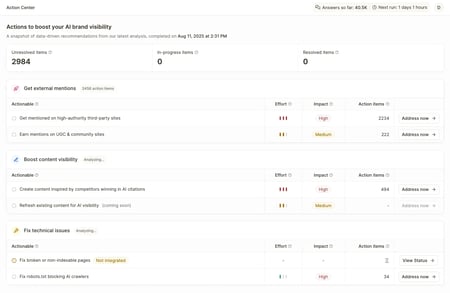
Writesonic's Action Center (2025 interface)
The Outreach Agent
The Outreach Agent is the release I came to see. It takes the off-page list and does the SDR work that agencies, mine included, still do manually.
The workflow starts with the third-party pages AI answers cite for your space, ranked by how many answers cite each one and filterable by AI platform or by the brands a page already mentions. The agent then finds a contact for each page, drafts an email tailored to why your brand fits that page, and sends it once you approve. Replies land in one inbox inside Writesonic, pitches with no answer are flagged for follow-up, and every opportunity moves from Suggested to In progress to Done[2]. You can approve each send one by one or bulk-select and let it run[3].
What Writesonic told me about how it works
The public page leaves the sending mechanics out, so I asked. Writesonic's team gave me four answers in November 2026.
- Contacts. The agent targets the specific author of each cited page, found by Writesonic's own algorithm. In most cases that is the author named on the page.
- Replies. Only the first email is drafted for you. You handle the replies yourself, with an "Edit with AI" option to draft responses quickly.
- Sending domains. Emails go out from dedicated, pre-warmed sending domains that Writesonic runs. That keeps your company domain's deliverability safe and saves you setting up sending domains yourself.
- Warm-up. Warm-up runs per sending domain and takes roughly 20–30 days.
Two of those answers shape how I would use it. A pitch sent from a Writesonic-run domain will read differently to some editors, so the email copy has to carry the brand on its own. The warm-up also means the first month of a new client is mostly preparation, which is worth agreeing with the client up front.
Tailoring is the other variable. Writesonic says each draft is written to explain why your brand fits the page[2], and its content agent works from a brand kit of tone, vocabulary, banned phrases and examples kept separate for each client[8]. The quality of the pitch will depend on how well that kit and the client's facts are maintained.
Fact Check, Citation Decay and Page Tracker
Fact Check shows the claims AI engines make about your brand that are wrong, and traces each one to the page the AI cited[3]. That list doubles as an outreach list. Every source spreading an outdated price or a wrong feature claim is a third-party site to correct. Pricing deserves the first look, since Profound's research across its own customers found pricing and billing to be the most common topic of inaccurate AI claims[15].
Citation Decay gives every cited page a status over a 14-day window, from Rising and Holding to Declining, Faded and Recovering, along with its peak citation share and half-life[5]. Faded pages are the refresh queue. Page Tracker then follows any URL over time, on your domain or someone else's, with citation trends by platform and the competitors that appear alongside you[6]. Once outreach earns a mention, that is how you show the client the page is now working for them. Both Fact Check and Page Tracker are listed as Enterprise features on the pricing page[1].
MCP, content agent and AI traffic
The MCP server lets you query visibility, citations, sentiment, competitor gaps and the Action Center from Claude, ChatGPT, Cursor, n8n, Notion AI and other clients. It can also make changes, such as adding tracked prompts or managing competitors, and shows each write action for confirmation before it runs[7].
The AI Content Agent writes blogs, product pages, case studies, LinkedIn posts and sales emails from a per-client brand voice, and publishes to WordPress, Sanity, Contentful, Contentstack, Drupal, Notion and Google Docs, with HubSpot, an API and MCP among its connections[8]. Each piece goes through research, writing and a second expert review before a final polish, which is the step I would check first on a client account.
AI traffic analytics has grown up too. My first review flagged that crawler tracking only worked on WordPress, Cloudflare and Vercel. Writesonic now connects to Cloudflare, AWS CloudFront, WordPress, Vercel, Drupal, Fastly, Shopify or a custom log drain[10].
Data quality
Writesonic collects its data by scraping the live interfaces of AI platforms and running searches from different locations, so the answers reflect what a user in each market sees[11]. In the 2025 test, the reports moved with the work. When SEO improved, citations went up, and when it slipped, visibility dropped. I treat it the way I treat every tool in this category, as directional data good enough for decisions and client reporting, with none of them definitive.
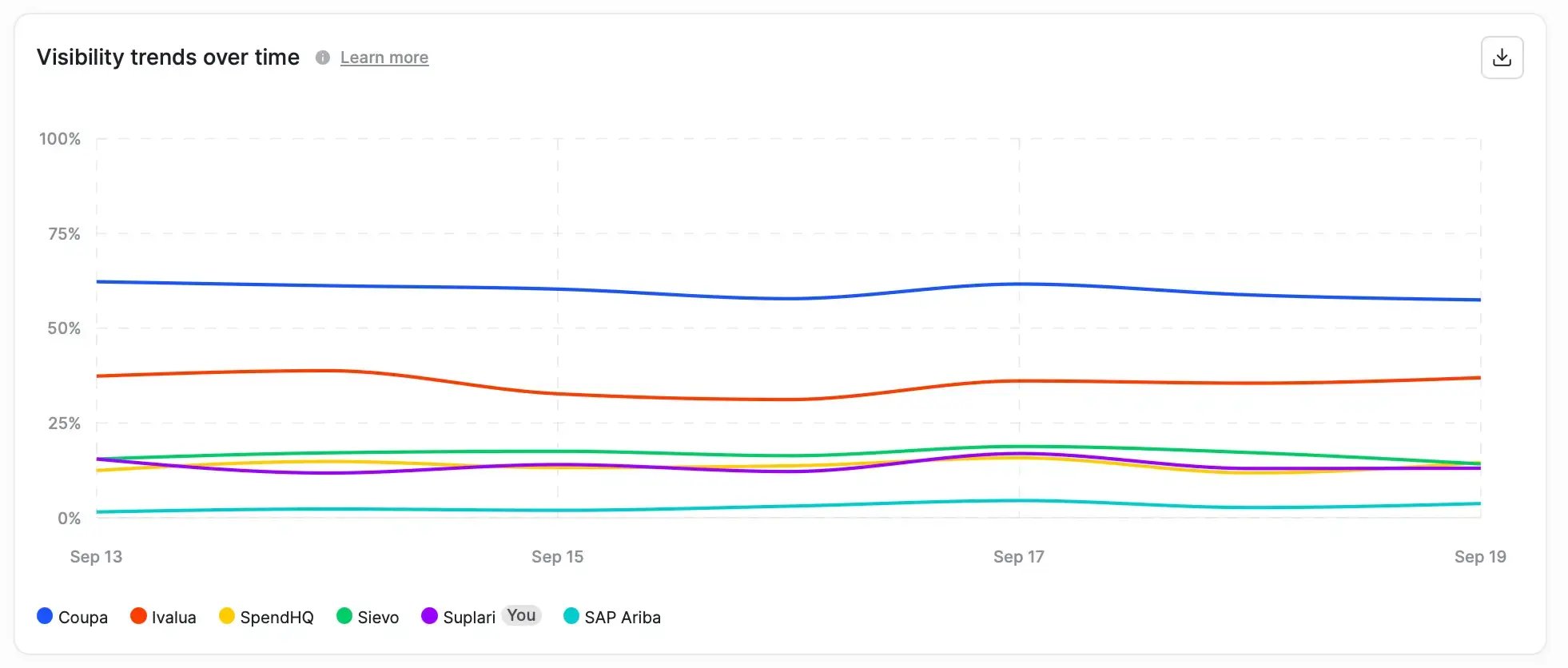
Visibility trends dashboard (2025 interface)
Where Writesonic falls short
The best features sit on Enterprise
Starter, Basic and Growth track ChatGPT, Gemini and AI Overviews. Perplexity, Claude, Grok and AI Mode need Enterprise, and so do Fact Check, Page Tracker and the uncapped Action Center[1]. A team buying Growth for the outreach story gets five off-page actions a month and has to request the Outreach Agent as an add-on[3].
Outreach takes a month to start
With 20–30 days of warm-up per sending domain, the agent will not deliver mentions in a client's first few weeks. Plan the first month around refreshes and Fact Check findings, with outreach volume building in month two.
Attribution still lives in GA4
Writesonic shows AI crawler visits and referrals, and Page Tracker connects a mention to a page's citation trend. Pipeline and revenue from AI search still have to be tracked in GA4 or your CRM.
Writesonic for agencies
A year ago Writesonic's bundled annual pricing was the reason I didn't use it for client work. Agencies onboard and offboard clients month to month, and an annual bundle doesn't fit that. Writesonic's agency team now offers monthly pricing per client with no client minimums, adjusted as clients come and go, plus custom client-facing packages.
Project Hub shows every client brand on one screen with visibility, citation share and trend lines, and its Looker Studio connector supports cross-client reporting[9]. Combined with the Outreach Agent, that puts the GEO tool and the SDR workflow in one product, which is the gap I came looking for.
Writesonic alternatives
Promptwatch is the tool I use for client visibility work today. Plans run $95, $245 and $579 a month, MCP and API come on every plan, and seven or more engines are tracked from the entry tier[12]. Its pricing page lists no outreach features, so off-page work stays manual[12]. Read my Promptwatch review.
Peec AI suits agencies that want flexible prompt allocation across clients, with Starter at $95 a month and dedicated agency bundles[13]. It focuses on tracking and lists no outreach features.
Profound fits larger teams with many audiences to manage, and its FactCheck compares AI claims against your own source of truth and shows which cited URLs drive the inaccurate ones[14]. Read my Profound review.
Who should use Writesonic
Writesonic fits B2B teams and agencies that already know their visibility numbers and now need to change them. The strongest case is a team with a large existing blog to refresh and a list of third-party pages it should be on. If you only need a visibility score across many engines, Promptwatch tracks more engines on its entry plan. If you want tracking, refreshes and outreach in one place, Writesonic is the one to trial, ideally side by side with your current tracker on one or two clients.
Frequently asked questions
Writesonic FAQ
How much does Writesonic cost?
Starter costs $79 a month, Basic $199 and Growth $399, all billed annually, and Enterprise is custom[1].
What is the Writesonic Outreach Agent?
Does Writesonic send outreach from my own domain?
No. Writesonic told me emails go out from dedicated, pre-warmed sending domains it manages, which protects your company domain. Each sending domain warms up for roughly 20–30 days.
Which AI engines does Writesonic track?
Starter, Basic and Growth track ChatGPT, Gemini and Google AI Overviews. Enterprise covers all eight engines, including Perplexity, Claude, Grok and Google AI Mode[1].
Does Writesonic have an MCP server?
Yes. Since June 2026 you can query and update your Writesonic data from Claude, ChatGPT, Cursor and other MCP clients, confirming each write action before it runs[7].
Is Writesonic good for agencies?
Yes, especially for agencies that do off-page work. Project Hub shows every client brand on one screen[9], and Writesonic's agency team offers monthly per-client pricing with no client minimums.
Sources
- Writesonic, Pricing
- Writesonic, Outreach Agent
- Writesonic, What's new in Writesonic (November 2026)
- Writesonic, AI Visibility Action Center
- Writesonic, Introducing Citation Decay
- Writesonic, Page Tracker and Portfolios
- Writesonic, Writesonic MCP
- Writesonic, AI Content Agent
- Writesonic, Introducing Project Hub
- Writesonic, AI Agent Analytics
- Writesonic Docs, Why we monitor real AI platforms
- Promptwatch, Pricing
- Peec AI, Pricing
- Profound, FactCheck
- Profound, Where do inaccurate AI claims come from?
Find out what AI says about you. A 30-minute call. I’ll have looked before we speak.

My Peec AI Review for AI Search Visibility [Updated October 2026]
Best AI Search Visibility Tools for 2027: 40+ Tested, Sorted by Buyer