


Answer Engine Optimization (AEO) is the practice of getting your content extracted as the direct answer on search-engine answer surfaces: Google AI Overviews and AI Mode, featured snippets, Bing and Copilot answers, and voice assistants. Generative Engine Optimization (GEO) is a separate discipline that shapes how standalone AI assistants such as ChatGPT, Gemini and Perplexity understand and recommend your brand. This guide explains the difference and how to build an AEO strategy.
|
Key Takeaways
|
Why SEO alone no longer covers search
The search landscape is going through its biggest change since Google ended the portal era. With Google AI Overviews, AI Mode, Copilot, ChatGPT and Perplexity, people increasingly get a direct answer instead of a list of links. For marketers and SEO professionals, that changes what "being found" means.
Answer Engine Optimization is the response on the search-engine side of this shift. It does not replace SEO. It extends the goal from ranking a page to having that page lifted into the answer itself.
How large language models differ from traditional search engines
To see where AEO stops and GEO starts, it helps to understand how search engines and large language models (LLMs) process and deliver information. The differences are technical, and they have direct consequences for content strategy.
Traditional search engines: index, rank and link
Search engines like Google operate on a crawl, index and rank model. Crawlers continuously scan the web and index pages into large databases. When a user submits a query, algorithms weigh ranking factors such as relevance, authority, backlinks and user signals to produce a list of results. The search engine acts as a librarian, pointing users to sources rather than answering questions directly.
Key characteristics of traditional search include real-time or near-real-time indexing, transparent source attribution through clickable links, ranking based on measurable signals like authority and backlinks, and the user's responsibility to evaluate and combine information from several sources.
Large language models: synthesise and generate
LLMs like GPT, Claude and Gemini work differently. They are trained on large text corpora and learn statistical patterns in language that let them generate contextually appropriate responses. When you ask ChatGPT a question without web search switched on, it is not searching the web. It generates an answer from patterns learned during training. With retrieval switched on, it also pulls in live sources.
This creates several important distinctions. LLMs have knowledge cutoff dates, so they may not know about recent events. They synthesise information rather than always citing sources, which can make verification difficult. They can produce fluent but incorrect answers (hallucinations). And they lean on authoritative, well-structured content in their training data.
Search engines vs. LLMs: key differences
|
Characteristic |
Search Engines |
LLMs |
|---|---|---|
|
Information delivery |
List of ranked links, increasingly with an AI answer on top |
Synthesised direct answer |
|
Data freshness |
Real-time indexing |
Training data cutoff (unless retrieval is used) |
|
Source attribution |
Explicit clickable links |
Often implicit or absent |
|
User action required |
Click through to sources |
Answer consumed directly |
|
Ranking signals |
Backlinks, keywords, technical SEO |
Brand authority, content quality, citation frequency |
These differences are why we split the work in two. Answer surfaces inside search engines still draw on pages the index already ranks, so SEO skills carry over directly. Standalone assistants are shaped more by brand mentions, authoritative citations and how consistently the web describes you, which is the territory of GEO.
How Google AI Overviews are changing the SERP
The most visible sign of AI in search is Google's AI Overviews (formerly Search Generative Experience or SGE), now joined by AI Mode. These AI-generated summaries appear at the top of results for a growing share of queries and change how users interact with the page. Our guide to getting visibility in Google AI Overviews and AI Mode covers the practical side.
The rise of zero-click search
Zero-click searches happen when users get their answer from the results page without visiting any website. Featured snippets and knowledge panels started the trend years ago, and AI Overviews are speeding it up.
The result is what we call the "crocodile mouth" problem: impressions rise while clicks fall. Your content may appear in more searches than ever while fewer people visit your site. For businesses that built their marketing on organic search traffic, this is a serious challenge.
What this means for your content strategy
AI Overviews change what it means to win in search. Position one is worth less if users never click. The new objectives are being cited as a source inside the AI answer, having your brand named in the summary, offering value a summary cannot replicate, and building direct relationships with your audience.
Traditional SEO still matters here. Pages that rank well are more likely to be cited in AI Overviews, which is exactly why AEO grows out of SEO.
The broader AI search ecosystem
Google is only one part of the picture. People also turn to Microsoft Copilot, ChatGPT, Perplexity, Claude and other assistants for information. Copilot answers inside Bing behave much like Google's AI features because they draw on a search index (see our guide to visibility on Microsoft Copilot). Standalone assistants work differently, and our guide to visibility on ChatGPT covers that side.
AEO vs. GEO
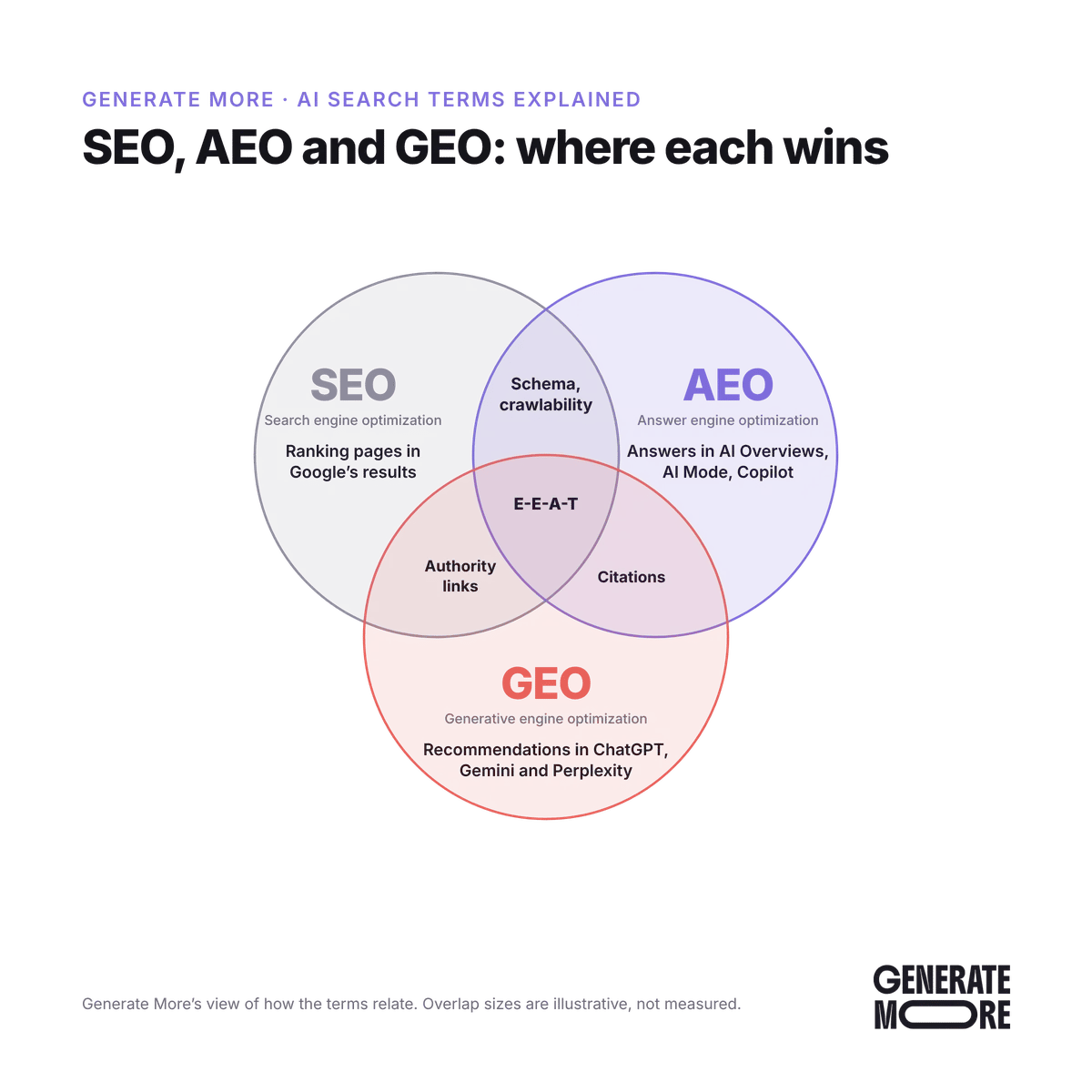
As AI search has grown, so has confusion about the terms. Answer Engine Optimization (AEO) and Generative Engine Optimization (GEO) are often used interchangeably. We use them for two distinct jobs, as explained in our AEO vs GEO comparison.
What is answer engine optimization (AEO)?
AEO focuses on the answer surfaces inside search engines: Google AI Overviews and AI Mode, featured snippets, Bing and Copilot answers, and voice assistants. The goal is for your page to be the one extracted as the answer. Because these surfaces draw on pages the search index already trusts, AEO is built on SEO: question-led headings, a direct answer in the first 40 to 60 words of a section, structured data, and pages that rank.
Google takes the same view. Its guide to generative AI features in Google Search says that optimizing for generative AI search "is optimizing for the search experience, and thus still SEO". That is why we treat AEO as the part of the work that grows out of SEO, while GEO covers the assistants that sit outside the search results page.
What is generative engine optimization (GEO)?
GEO focuses on standalone AI assistants such as ChatGPT, Gemini, Perplexity and Claude, where people go directly to ask questions and get recommendations. The goal is for the assistant to understand your brand correctly and recommend it. GEO work centres on entity consistency, third-party mentions, reviews, digital PR and presence in the sources these assistants rely on. Our list of top generative engine optimization agencies covers the firms that specialise in it.
Put simply: AEO wins the answer, GEO wins the recommendation
Earlier versions of this guide described AEO as SEO plus GEO. We now treat them as two disciplines with different targets, because that makes it clearer who owns each part of the work and how each is measured. Most B2B companies need both, run as one coordinated system alongside SEO.
AEO vs. GEO at a glance
|
Aspect |
AEO |
GEO |
|---|---|---|
|
Target surfaces |
Google AI Overviews and AI Mode, featured snippets, Bing and Copilot answers, voice assistants |
ChatGPT, Gemini, Perplexity, Claude |
|
Goal |
Your page is extracted as the answer |
Your brand is understood and recommended |
|
Grows out of |
SEO |
Brand, PR and entity work |
|
Key tactics |
Answer-first structure, schema, rankings, page experience |
Entity consistency, third-party mentions, reviews, digital PR |
|
How to measure |
Citations in AI Overviews and snippets, Search Console impressions and clicks |
Mention rate and share of voice in assistant answers |
Implementing an AEO strategy
An AEO programme has four layers. Each one builds on the one before it.
Foundation: keep SEO in good shape
Pages that rank well in organic search are the pool AI answer surfaces draw from. Keep working on technical SEO, quality content, site speed, mobile experience and authoritative backlinks. These factors drive both rankings and answer-surface citations.
Structure: write for extraction
Answer surfaces favour well-structured, clearly written content. Use question-and-answer formats where they fit, put a concise factual summary at the start of each section, keep a logical heading hierarchy, and write definitive, quotable statements that can be lifted without editing.
Markup: add structured data
Schema markup tells search engines what a page is and who stands behind it. Organization, Article, FAQ and HowTo markup, plus a consistent company name and description across your site, make it easier for an answer surface to trust and attribute your content.
Monitoring: track answer-surface visibility
Track which queries trigger AI Overviews for your pages, whether you are cited, and how impressions and clicks move in Search Console. Our comparison of AI search visibility tools covers the trackers that do this, and the AEO World Map shows tools and agencies by region.
Where AEO hands over to GEO
Brand authority decides a lot once you move beyond the search results page. When several sources say similar things, AI assistants favour brands that are consistently described and mentioned by trusted third parties. PR, thought leadership, reviews and expert citations belong to GEO, and they work best when the AEO foundation is already in place.
Bottom line: AEO is where SEO meets the answer
AEO is the evolution of SEO for search engines that answer instead of only listing links. GEO is its partner discipline for the assistants people use outside search. Use AEO to win the answers inside Google and Bing, use GEO to shape how ChatGPT, Gemini and Perplexity describe you, and run both with SEO as one system.
The brands that do well here build genuine authority, publish content that a summary cannot replace, and stay visible both inside search and in the assistants. The crocodile mouth may keep widening, but with the right structure your brand can stay ahead of its jaws.
|
Ready to optimize for AI search? Generate More helps B2B and international tech companies get found, described correctly and recommended in AI answers. See our AEO services to learn how we build visibility across Google AI Overviews, AI Mode, Copilot, ChatGPT and Perplexity. |
How CMOs Should Approach AI Search and AEO Beyond Traditional SEO in 2027

How to Get Visibility on Google AI Overviews (and AI Mode)