
This guide is by Lari Numminen, founder of Generate More Oy, a Helsinki-based AEO and AI SEO agency for Nordic and international B2B software companies. Generate More finds out what ChatGPT and Google's AI say about a company, and fixes what sits underneath.
I've helped many B2B companies recover organic traffic after Google's core updates, and one lesson keeps repeating. People change how they search, and the need to be found stays. Going into 2027, being found increasingly means being named in an answer written by AI.
Generative engine optimization (GEO) is the work of making your company and your content easy for AI search tools to find, understand and cite in their answers. Classic search engine optimization aims for a high ranking in Google's results, while GEO aims for a place inside the answer that ChatGPT, Perplexity, Copilot or Google's AI Overviews write for your buyer.
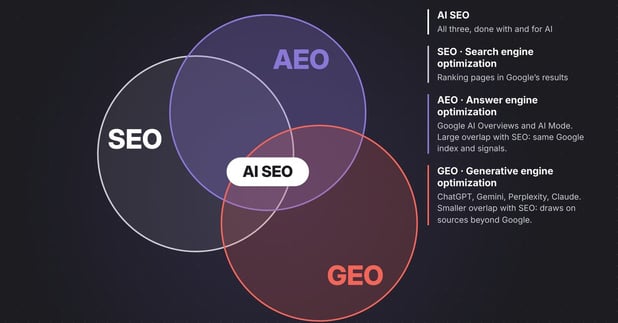
GEO, AEO and AI SEO: one goal, several names
The field is new enough that it has several names, and Finnish agencies use them interchangeably.
| Term | What it usually means |
|---|---|
| GEO | Optimizing for answers written by generative AI engines such as ChatGPT and Gemini; the Finnish term is tekoälyoptimointi |
| AEO (answer engine optimization) | Optimizing for any system that answers instead of listing links, including Google's AI Overviews and AI Mode |
| AI SEO | Search engine optimization done with and for AI; the broadest of the three |
What matters is the outcome. When a buyer asks an AI assistant about your category, your company should appear, and it should be described the way you would describe it yourself.
How GEO compares to traditional SEO
GEO builds on SEO and changes what counts as winning. The table sums up the differences I see in client work.
| Traditional SEO | GEO | |
|---|---|---|
| Goal | A high ranking for a page | Being named and described correctly in the answer |
| What competes | Whole pages | Passages, and mentions of your brand across the web |
| Strongest signals | Relevance, links, technical health | Clear answers, content depth, third-party mentions |
| Where you measure it | Search Console and rank tracking | AI visibility tools that run buyer prompts |
| How fast results change | Months | Weeks |
The foundation is shared. A page that Google cannot crawl or does not trust will rarely be cited by its AI either, which is why the guide to search engine optimization in Finland is the place to start.
Why GEO matters for B2B companies in Finland
AI answers now sit between your buyer and your website. Pew Research Center followed 900 American adults through March 2025 and found that when Google showed an AI summary, people clicked a regular result in 8% of visits, compared with 15% without one. They ended their browsing session on 26% of pages with a summary, against 16% without.
Ahrefs measured the same effect from the publisher's side. Comparing December 2023 with December 2025 across 300,000 keywords, an AI Overview now correlates with a 58% lower click-through rate for the first organic result (Ahrefs).
Interest in Finland is new and growing. "Tekoälyoptimointi" gets about 600 searches a month and "geo optimointi" about 200, according to Ahrefs Keywords Explorer, and Google already answers the first of them with an AI Overview. When I checked the brand searches of Finland's 100 largest listed companies, 20 showed an AI Overview (see the study).
Finnish buyers are part of this shift. According to Statistics Finland, 41% of Finns aged 16–89 used generative AI in the past three months in 2025, and 33% used it to search for information, up from 14%.
For a B2B company the risk is quiet. Fewer clicks show up in analytics as a dip. The bigger loss is the buying conversation where an AI answer recommended a competitor, or described your company as something it no longer is, and you never saw it happen.
How AI search platforms choose what to cite
AI search tools do not rank whole pages the way Google's classic results do. They break content into passages and pick the most useful pieces to build an answer. Google calls its own version "query fan-out", in which AI Mode issues "multiple related searches across subtopics and data sources" to develop one response (Google Search Central). Kevin Indig analyzed over 7,000 citations across 1,600 URLs in AI chatbots and found three patterns (Search Engine Journal).
Content depth and readability matter most
Word count, sentence count and readability had the biggest impact on whether a page was cited. A page that goes deep on a topic answers more of the questions an AI system breaks a query into, which gives it more chances to be picked.
Brand popularity raises mentions
Brand search volume correlated with AI chatbot mentions at 0.334. People searching for your name is a signal that you are a known option in your field, and AI tools reflect that.
Some traditional SEO signals count for less
The top 10% of most-cited pages had less traffic, ranked for fewer keywords and had fewer backlinks than the rest. Links and domain authority still help you rank in Google. For AI citations, the quality of the content itself was the stronger predictor.
Google adds one caveat for its own AI features, stating that "there are no additional requirements to appear in AI Overviews or AI Mode, nor other special optimizations necessary." Everything below builds on solid search engine optimization.
Step 1: Check what AI says about you today
Start with the answer your buyers already see. Ask ChatGPT, Google's AI Mode, Perplexity and Copilot three questions: what your company does, who the leading providers in your category are, and how you compare with your closest competitor. Ask in Finnish and in English, because the answers often differ.
Write down every gap. Typical findings are an outdated description after an acquisition, a product line you discontinued, a competitor recommended in your place, or no mention at all. These gaps become your priority list, and they tell you whether the problem sits in your own content or in what others have written about you.
Step 2: Structure content for AI retrieval
AI platforms read content in passages, so every section of a page has to stand on its own. A reader may land in the middle of a page, and an AI system always does.
Make each section self-contained
Aleyda Solis's AI search optimization checklist recommends "descriptive headings, direct answers, named entities, explicit criteria and self-contained tables." In practice, give every topic its own H2 or H3, open each section with the direct answer, keep each paragraph on one idea, and avoid phrases that rely on an earlier section for context.
Use a natural question-and-answer format
AI systems pick up content that answers a question in the words the question was asked. Here is a short example.
Question: What is predictive maintenance?
Answer: Predictive maintenance uses data analysis to forecast when equipment will fail, so companies can service it just before problems occur.
A page built from pairs like this is easy for an AI system to quote accurately. It also forces you to state the answer plainly, which helps human readers too.
Add structured data
Schema markup tells machines what each part of a page is. The four types most B2B sites need are FAQPage for question-and-answer sections, Article for blog posts, Organization for company details, and Product or SoftwareApplication for product descriptions.
Step 3: Create content AI platforms trust
Include specific, verifiable claims
Cite data with a link to its source, quote named experts, reference research and keep statistics current. A sourced claim is one an AI system can check, which makes it safer to repeat.
"You can't compete with the big players on everything. But if you use tools like AI automation and generative content production, you can at least beat them at one thing, and then take it to the extreme." Lari Numminen
Show expertise and authority
AI platforms favor content that demonstrates E-E-A-T, short for experience, expertise, authoritativeness and trustworthiness. Add author bios with real credentials, keep company details consistent on your About page and in structured data, link to authoritative sources, and show real experience through customer stories such as the Workfellow case study.
Keep content fresh
Picture a buyer opening an article titled "Best practices for 2027" and finding it was last updated in 2023. AI systems weigh recency for the same reason that buyer loses trust.
Citations also fade fast. Profound tracked 1.19 million page and engine lifecycles across seven AI platforms from September 2025 to September 2026 and found that the median page loses half its citation share within 11 days of peaking. Even pages with lasting citations had a median half-life of 27 to 29 days (Profound). Show a visible update date, refresh key figures on a schedule, and plan to publish steadily.
Step 4: Build topical authority with content clusters
Query fan-out rewards sites that cover a topic from every angle. If AI Mode splits one buyer question into ten sub-searches, a site with ten relevant pages has ten chances to be cited.
Build a hub-and-spoke model. A pillar page covers the broad topic. Cluster pages go deep on subtopics and link back to it. A company selling integration software, for example, might publish a pillar called "The complete guide to API integrations" supported by "REST vs SOAP", "API security best practices" and "Integration testing methods".
Cover each topic across search intents too, from what something is and how the options compare to how to do it well. Each intent is a different sub-question in a fan-out search.
Step 5: Optimize for multimodal AI search
AI search systems increasingly use images and video alongside text. Give every image descriptive alt text with the topic's context, add captions and transcripts to video, serve images in clean HTML, and use real HTML tables for data. Semantic markup helps machines extract visual content correctly: <figure> for images with captions, <table> for data, <ul> and <ol> for lists, and a logical H1, H2, H3 hierarchy.
Step 6: Make sure AI crawlers can reach your site
AI platforms can only cite content they can fetch. Check your robots.txt and make sure the crawlers that matter are allowed: GPTBot (OpenAI), Googlebot and Google-Extended, Bingbot, ClaudeBot and PerplexityBot. Blocking them means losing citations.
Many AI systems also struggle with JavaScript-heavy pages. Your key content should be rendered on the server, readable without JavaScript, available as clean HTML, and fast on mobile. Service pages built from carousels and tabs are a common blind spot on B2B sites.
Step 7: Earn mentions beyond your own site
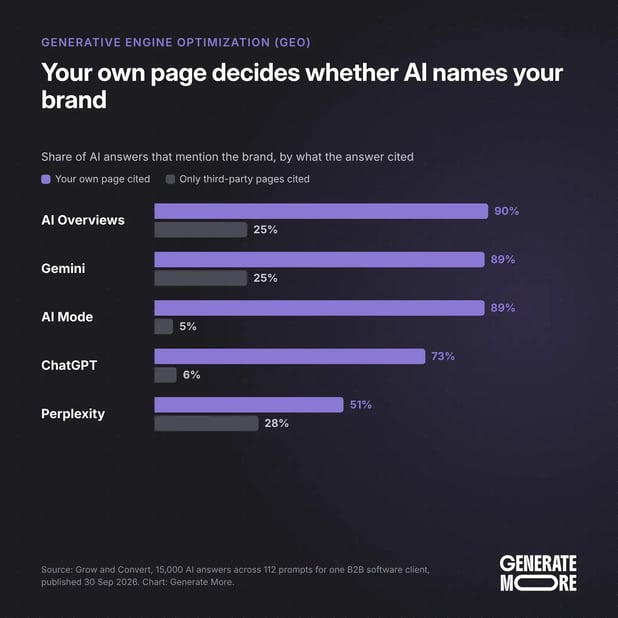
Your own pages come first. Grow and Convert analyzed 15,000 AI answers for one B2B software client and found that when the client's own site was cited, the brand was mentioned in 90% of AI Overviews answers and 73% of ChatGPT answers. When only third-party pages were cited, those rates fell to 25% and 6% (Grow and Convert). A page that matches the buyer's question is the foundation.
Third-party sources then widen your reach. Writesonic studied 2,007 brands and found that a mention on YouTube made a brand 3.19 times more likely to appear in AI answers, with Reddit at 3.17 times and Gartner at 3.15 times (Writesonic). AI models assemble a description of your company from everything published about it, from trade press and analyst reports to "best of" lists, review sites, Wikipedia and LinkedIn.
Your tracking tool will show the five to ten sources AI tools cite most in your category. Work to be present on those with the description you want. That might mean a guest article in a trade publication, an accurate profile on review platforms or a place in the relevant agency and vendor lists. I keep a current list of Finnish and international providers in the AEO World Map.
Step 8: Track and measure AI search performance
GEO needs different measurements than classic SEO, because Search Console reports only on Google's classic results. Leadership is already asking for them. In uSERP's survey of 116 SEO professionals, 48.3% had been asked by a client or senior leader to make AI citations a formal KPI in the past year, and another 31% as an informal target (uSERP).
Track mentions across AI platforms
Monitor when your brand or content appears in ChatGPT answers, Perplexity citations, Google AI Overviews and AI Mode, Copilot and Claude. Dedicated tools automate this, and I've tested over 40 of them in the AI visibility tool comparison.
Measure what the answers say
Look past impressions and traffic to four content metrics. Citation frequency shows how often your content is referenced. Answer accuracy shows whether AI platforms describe you correctly. Brand association shows which topics AI connects your company with. Referral traffic shows the clicks that do come from AI citations.
Test and iterate
Ask the same set of buyer questions in ChatGPT, Perplexity, AI Mode and Copilot every month. Note which content gets cited and where only competitors appear, then update the content based on what you learn.
Common mistakes in GEO
Working with dozens of companies, I see the same five mistakes again and again. Most come from treating AI search as an add-on to classic SEO.
The first is measuring only classic SEO. Rankings and backlinks say little about AI visibility, so a team watching only those numbers misses the shift.
Generic AI-written content is the second. AI platforms recognize thin, generic text and pass over it. Your expertise and original insight count for more than ever.
Many companies also neglect technical SEO and block AI crawlers by accident, or serve content that AI systems cannot parse. A ten-minute robots.txt check catches most of it.
A fourth mistake is ignoring conversational queries. AI search is a conversation, and your content has to answer the questions your audience actually asks.
The last is overlooking brand authority. AI platforms favor brands they recognize, which makes PR and third-party mentions part of AI visibility work.
Summary
GEO comes down to giving better, more accessible answers to your audience's questions, and making sure the rest of the internet describes your company accurately. Companies that check what AI says about them now, and fix what sits underneath, will be the ones buyers hear about first.
Frequently asked questions
What is generative engine optimization (GEO)?
Generative engine optimization (GEO), tekoälyoptimointi in Finnish, is the work of making a company's content easy for AI search tools such as ChatGPT, Perplexity and Google's AI Overviews to find, understand and cite. Its goal is to be included and described correctly in AI-generated answers.
What is the difference between GEO and SEO?
SEO aims to rank pages in search results; GEO aims to be cited inside AI answers. They share the same foundations of crawlable, useful and trusted content, and GEO adds work on passage structure, query coverage and off-site mentions.
Is GEO the same as tekoälyoptimointi?
Yes. Tekoälyoptimointi is the Finnish term for GEO. AEO (answer engine optimization) is closely related and also covers Google's AI Overviews and AI Mode.
Do I need special optimization to appear in Google's AI Overviews?
Google says there are no additional requirements or special optimizations for AI Overviews or AI Mode (Google Search Central). Pages that are crawlable, indexed and genuinely helpful are eligible.
How do I know what ChatGPT says about my company?
Ask it directly, in Finnish and in English, and compare the answer with how you describe your company. For ongoing tracking, AI visibility tools run the same questions on a schedule across several AI platforms.
Search Engine Optimization in Finland: Key Trends and Market Characteristics for 2027
-1.png)
How to Get Visibility on Google AI Overviews (and AI Mode)