


By Lari Numminen, founder of Generate More, a Helsinki-based AEO and AI SEO agency for Nordic and international B2B software companies.
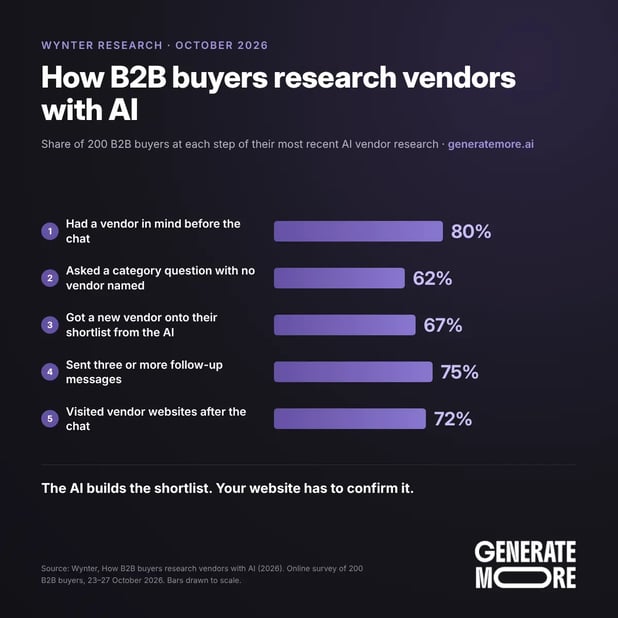
Your next customer probably knows your name and still won't type it. In a new Wynter study of 200 B2B buyers, 80% had at least one vendor in mind before opening an AI chat, yet 62% of first prompts were a plain category question that named no vendor. The AI then drafted the shortlist, the buyer interrogated it in follow-ups, and most buyers visited vendor websites afterwards to check what the AI had told them. All figures in this article come from that study.
For founders and heads of marketing at B2B software companies, that sequence changes what it means to be discovered in AI search. Getting named in one answer is the entry ticket. The vendors that stay on the shortlist are the ones the AI can still describe correctly after the buyer adds a budget cap, an integration requirement and the tool they want to replace. Below are the study's main findings, what each one means for your brand, and what I would change first depending on whether you run the company or the marketing team.
Key takeaways
- Buyers ask AI for the category. 62% of first prompts named no vendor, even though most buyers already had one in mind.
- Most shortlists gain a vendor from the AI. 67% of buyers said it introduced a vendor they had not considered that made the cut.
- The decision forms in the follow-ups. 75% sent three or more follow-ups, and 44% of buyers who picked a vendor after an open conversation did not see it in the AI's first answer.
- Your website is the confirmation step. 72% visited vendor websites after the chat.
- Discovery in AI search depends on three things you control: the category language you publish, public answers to the filters buyers apply, and a website that confirms fit within seconds.
How the Wynter study was run
Wynter surveyed 200 B2B buyers from its panel of verified professionals between 23 and 27 October 2026, screening for people who had used an AI assistant to research a software or service vendor for work in the previous 90 days. 44% worked at companies with 1,000 or more employees, and marketing (36%) and engineering and IT (34%) were the largest functions in the sample. Respondents described their most recent research episode, and two independent coders classified the prompts they wrote or pasted.
Two limitations shape how far the numbers travel. The panel skews toward technical roles and heavy AI users (71% used Claude and 62% ChatGPT), so the tool shares say nothing about the wider market, and the answers rely on recall more than chat logs. I read the percentages as direction, and the direction holds across every section of the report.
Buyers ask AI for the category, even when they know vendor names
Of the buyers who had a vendor in mind, 64% named none in their first prompt. One engineer in the study gave the reason in a single line: "I started broad. To get a list without my influence." Only 17% opened by asking for alternatives to a named vendor, and just 5% asked the AI to evaluate a single vendor.
Brand awareness gets you into the buyer's head, and the answer gets built somewhere else. Its reply comes from how it understands the category and whether it connects your company to the problem as the buyer phrased it. Suppose your site says "revenue intelligence platform" and the buyer asks for a tool that tells sales which accounts are ready to buy. Making that leap is left to the model, and it makes it more easily for a competitor whose pages already use the buyer's words.
The AI adds vendors to most shortlists
Two in three buyers (67%) said the AI introduced a vendor they had not considered, and that vendor made their shortlist. The rate reached 82% among buyers with no vendor in mind and stayed at 56% among buyers who arrived with two or three names.
An incumbent position in the buyer's memory no longer protects a vendor. Buyers who were actively building a shortlist got a new name more often (75%) than buyers who were only exploring the category (64%), so the effect reaches well into the evaluation. Wynter's own summary puts it plainly, describing the consideration set as co-written by the AI.
Buyers give the AI almost no context
The median first prompt contained one buyer constraint, and 30% contained none at all. Buyers believed they had said much more. Asked afterwards, they claimed 1.8 times as much context as they had actually written, with the widest gaps for their role (4% written against 22% claimed) and their industry (10% against 26%).
A thin prompt forces the AI to fill the gaps with assumptions about who each vendor is for, which company size it fits and what it replaces. Whatever you have published decides whether those assumptions land right. A buyer at a 40-person company who gets shown an enterprise-only product will rarely notice that the AI guessed, because they believe they told it their size.
The buying happens in the follow-ups
Almost every conversation continued after the first answer. 75% of buyers sent three or more follow-up messages, 34% sent six or more, and only 4% sent none. Pricing came up in 57% of conversations, comparisons of specific vendors in 55%, integrations in 46% and implementation in 40%.
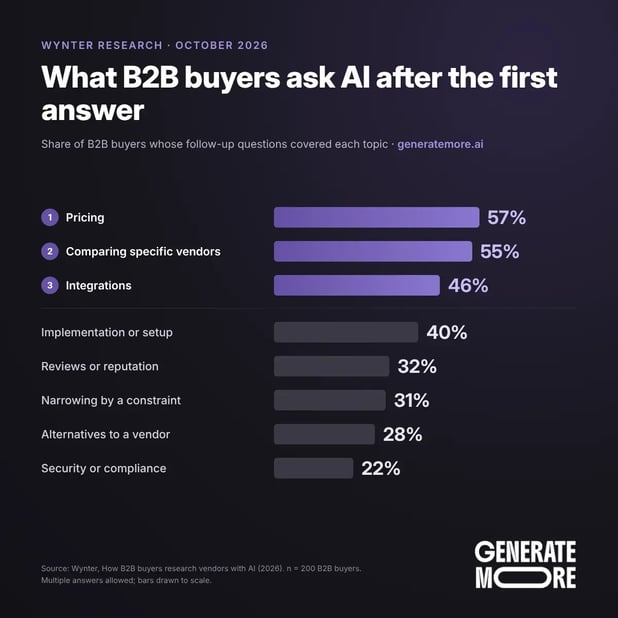
Vendors get cut in these turns. The first follow-up most often removes names by adding a filter or checking price, and 52% of conversations added a fact about the buyer that the opening prompt left out. Respondents told the AI to drop anything over a monthly budget, anything without an API integration to their marketing automation platform, and anything not based in the US. Your company survives that kind of turn only when the AI can find a clear, current public answer about your pricing, integrations, region and fit.
The first answer is a starting line
Among buyers who began with an open prompt, followed up and picked a vendor, 56% saw their eventual choice in the AI's first answer, 39% only after follow-ups, and 5% never saw it mentioned by the AI. Longer conversations moved further from the opening list. With six or more follow-ups, 51% of picks surfaced after the first answer, compared with 29% for conversations of two follow-ups or fewer.
Wynter flags these figures as directional, since many buyers who said they "chose" a vendor were still leaning toward it. Even so, a fixed list of one-shot prompts can only show the opening of a conversation that usually runs three to six turns.
The AI's description of you ends up in the buying memo
Some buyers hand the decision itself to the AI. 20% said they asked it to just recommend one vendor, and counting what they wrote in follow-ups the share rises to 30%. 36% asked at some point for a structured format such as a table or a ranked top three. About one in twenty asked for something meant for colleagues, such as an executive summary or slides.
The AI's take on your pricing and your weak spots can travel straight into the document your buying committee reads. A wrong price or an outdated description of your product does damage in a meeting you will never attend.
Then buyers check your website
90% of buyers took their research elsewhere after the chat, and 72% visited vendor websites, ahead of Google (48%), booking a demo or signing up (34%) and asking peers (31%). For 17%, the vendor site was the only check outside the AI. These visitors arrive with a shortlist and a budget in mind, and they need to confirm quickly who you serve and what you replace, plus a rough idea of cost.
Most of that journey stays invisible in analytics. The chat leaves no referral, and the visit that follows tends to show up as direct or branded traffic. I covered that measurement gap in Dark SEO: why your dashboard is hiding a third of your pipeline.
What this means if you are a startup founder
The study is good news for companies the market does not know yet. Buyers with no vendor in mind left the chat with a new name 82% of the time, and the AI only has to connect your product to the problem as the buyer describes it. Years of brand building are optional for that first shortlist slot.
The risk for a young company is absence. If almost nothing has been published about you, the AI has no record to work from and simply leaves you out. Three moves close that gap fastest.
- Write your homepage and product pages in the words buyers use for the problem, and ask a handful of target buyers how they would describe it before you settle the copy.
- Publish the facts buyers filter on in follow-ups, including a starting price or how pricing works, the integrations you support, the company sizes you fit and the regions you serve.
- Get described on pages the AI already trusts, such as third-party comparisons and review sites. My guide on how to get visibility on ChatGPT covers which of those sources carry the most weight.
What this means if you run marketing
For heads of marketing at established companies, the warning sits in one number. More than half of buyers who already had two or three vendors in mind still added a new one from the AI, which means a strong position in the buyer's memory can be undone inside one conversation.
- Build your AI visibility prompt sets as conversations. Start with the category question in your buyers' own words, then add the three to five follow-ups that carry their real constraints, and score how the AI describes you at each turn.
- Audit how the AI describes your pricing and your weaknesses, since that text may be pasted into a buying memo. My article on how CMOs should approach AI search and AEO lists the five page types that correct most wrong answers.
- Test the homepage and pricing page with people who match your ICP. A buyer arriving from a chat should be able to tell within seconds who the product is for and whether it fits the constraints they just gave the AI.
How to get your B2B brand discovered in AI search
Every step of the buyer journey in the study maps to something you can publish. The table below pairs each step with the page work that decides it.
| Buyer step | What decides it | What to publish |
|---|---|---|
| Category question (62% of first prompts) | Whether the AI links you to the problem in the buyer's words | Homepage and category pages written in buyer language |
| AI adds vendors (67% got a new one) | How clearly the AI can match you to the use case | Use-case and segment pages, third-party mentions |
| Follow-up filters (75% send 3+) | Public answers on price, integrations, size, region | Pricing page, integrations page, fit statements |
| Decision and memo (30% ask AI to pick) | What the AI says about your strengths and weaknesses | Comparison and alternatives pages with honest trade-offs |
| Website check (72% visit) | Whether the page confirms fit within seconds | A homepage that states who it is for and what it replaces |
Find out what AI says about you. A 30-minute call. I'll have looked before we speak. Book a call
B2B GTM Strategy for 2027: How CMOs Should Adapt Their Plans for AI Search
Generative Engine Optimization (GEO) in Finland: What Is It and How Does It Compare to Traditional SEO?
