

Finnish marketing teams adopted AI faster than almost anyone predicted, and they did it from the bottom up. Individual marketers started using tools before their organisations had a policy, a budget line, or an opinion. This article reports what 70 marketing leaders in Finland told us about how their teams actually use AI, which tools they reach for, what they expect from their agencies, and where the money goes.
Marketing leaders in Finland use AI most heavily for written content. In our survey of 70 CMOs, 84.3% of teams used AI for blog and website copy, 80% for creative thinking, and 60% for social media. Nine in ten said the main benefit was speed. Adoption ran well ahead of budget: only 43% had committed new money to it.
About this survey
We contacted 235 marketing leaders in Finland through LinkedIn and 70 responded, a 30% response rate. Respondents came from both B2B and B2C organisations, with the sample skewing towards internationally oriented software companies. Questions were answered in English.
Two things are worth stating plainly before the numbers. First, the survey was fielded in November 2023, so read it as a Finnish market baseline rather than a snapshot of this quarter. It captures the moment adoption went mainstream, which makes it useful as a comparison point rather than as a current-state report. Second, the questions asked about generative AI tools specifically, because that was the category that was new. Finnish marketing teams were of course already using AI in ad platforms, recommendation engines and analytics long before any of them opened ChatGPT. Where a finding is specific to generative tools, this article says so.
How Finnish marketing teams use AI
AI showed up first wherever marketing produces text. Website copy, campaign concepts and social posts led adoption by a wide margin, while audio and video lagged far behind.
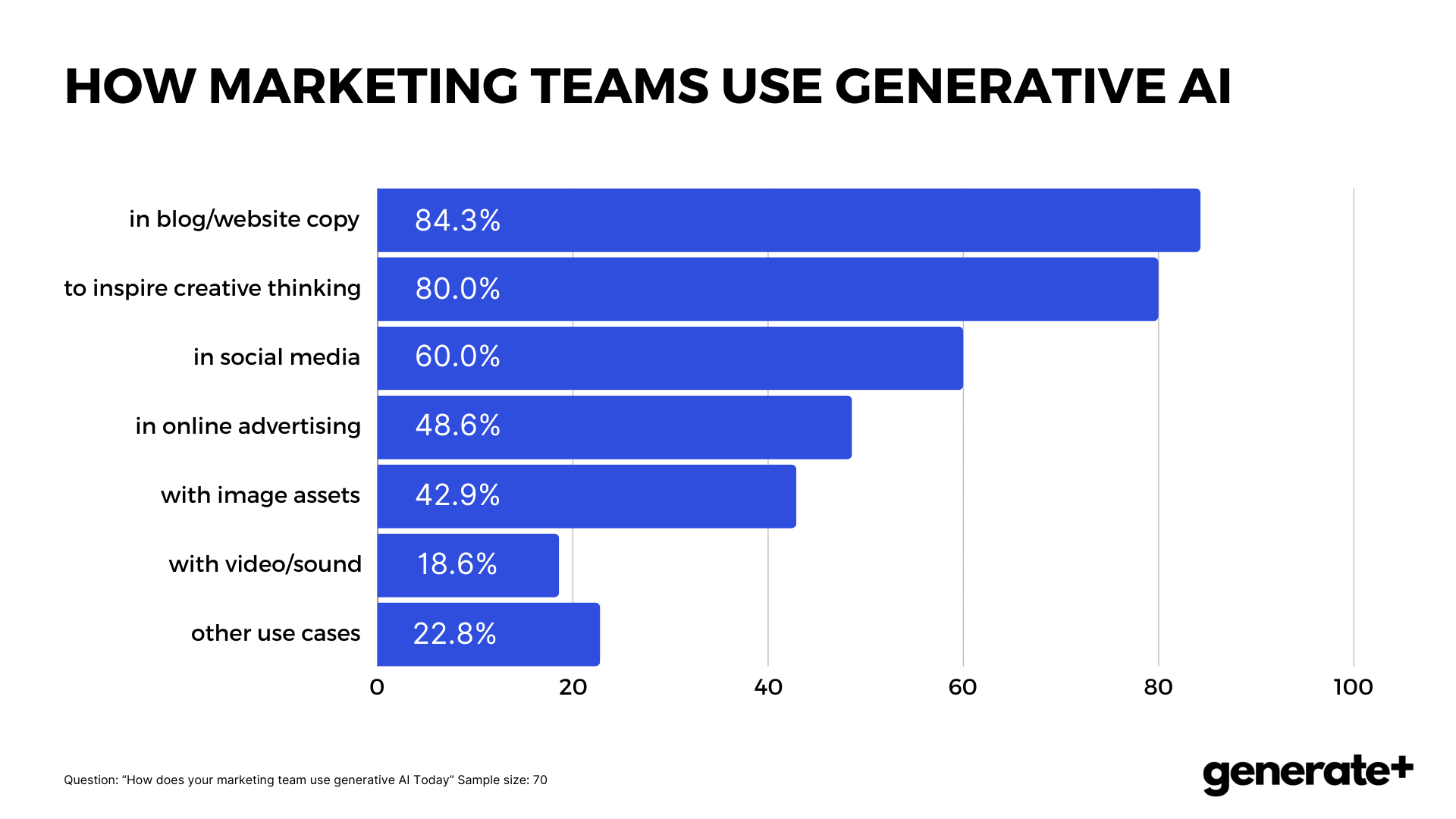
Blog and website copy, 84.3%. The clear front runner. Drafting, rewriting, expanding outlines and adapting one piece into several formats.
Creative thinking, 80%. Used as a sparring partner rather than a writer. Concepting, angle generation, and getting past the blank page in planning sessions.
Social media, 60%. Adapting a message to each channel and producing variants at volume.
Online advertising, 48.6%. Ad copy variants, audience hypotheses and campaign analysis.
Image assets, 42.9%. Illustration, concept visuals and editing, mostly to reduce dependence on stock libraries.
Video and sound, 18.6%. The laggard. Quality thresholds were higher and the tooling was less mature.
The pattern is consistent: adoption tracked how cheap it was to check the output. A marketer can read a paragraph and judge it in seconds. Reviewing a generated video takes real time, and getting it wrong is more visible. That gap has narrowed since, but the ordering it produced still shapes where most teams are strongest.
Which AI tools Finnish marketers use
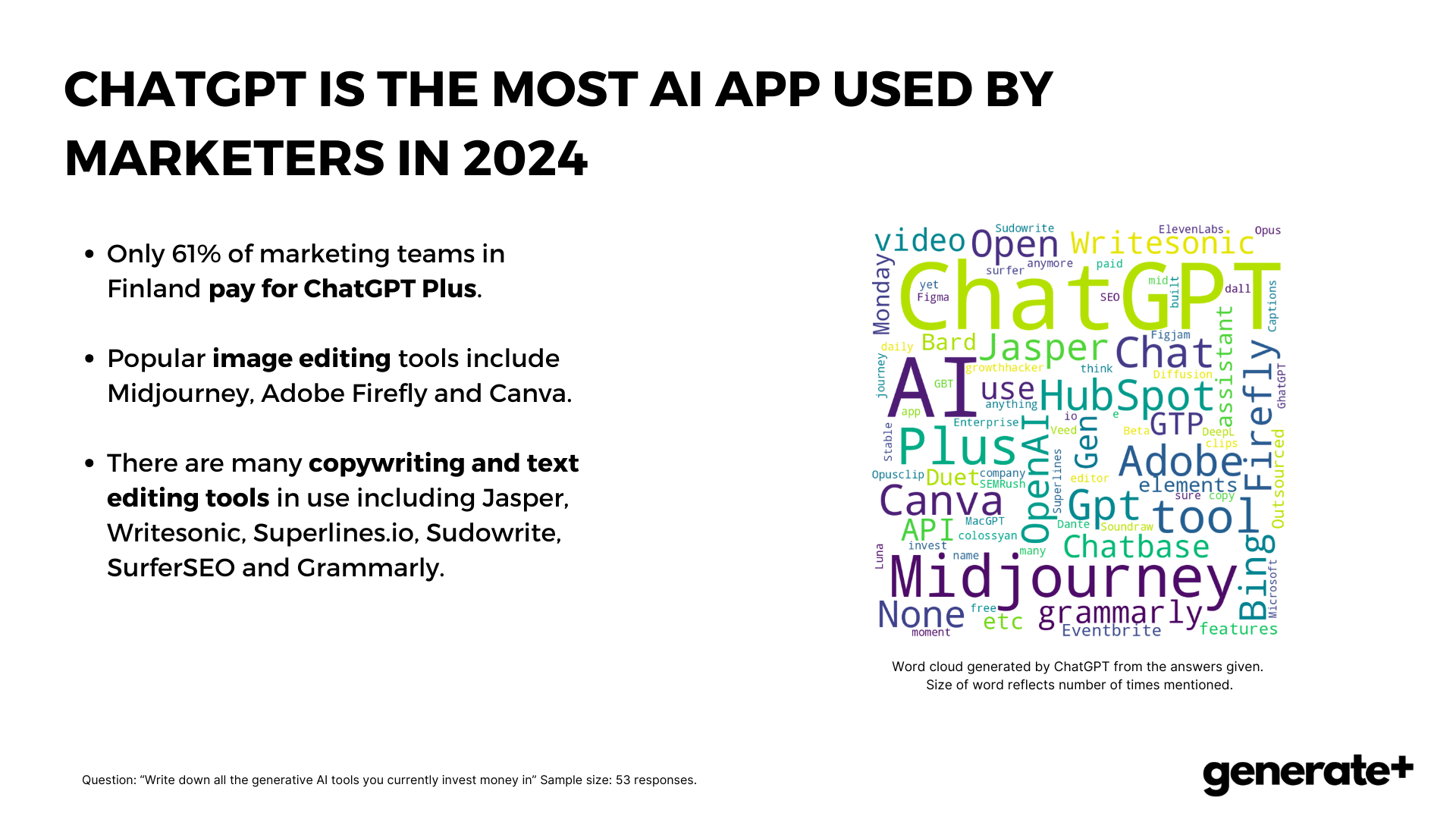
Across 70 marketing leaders we identified 40 different AI-powered applications in active use. That number is the finding. Marketing teams were not standardising on a stack, they were assembling one tool at a time, usually on individual credit cards.
Text and general assistants
ChatGPT dominated, and over 60% of teams were on the paid tier rather than the free one, which is a meaningful signal about perceived value. Purpose-built writing tools appeared alongside it: Jasper, Writesonic, Sudowrite, Superlines.io for messaging, SurferSEO for search-led drafting, and Grammarly as the editing layer nearly everyone kept. See what ChatGPT is and how large language models work for the underlying mechanics.
Images and design
Midjourney, Adobe Firefly and Canva led visual production. Canva mattered disproportionately because it put generation inside a tool non-designers were already using, which is usually how a capability crosses from specialists to the whole team.
Audio and video
ElevenLabs and Opus appeared, but thinly. This is the category where the gap between what the tools could do in a demo and what a brand would publish was widest.
Inside existing platforms
HubSpot's own AI features and AI inside Figma came up repeatedly. Nobody procures these separately, which is exactly why they spread quickly and why they rarely appear in an AI budget line.
How Finnish marketing leaders invest in AI
Adoption and investment moved at different speeds, and the gap between them is the most revealing part of the survey.
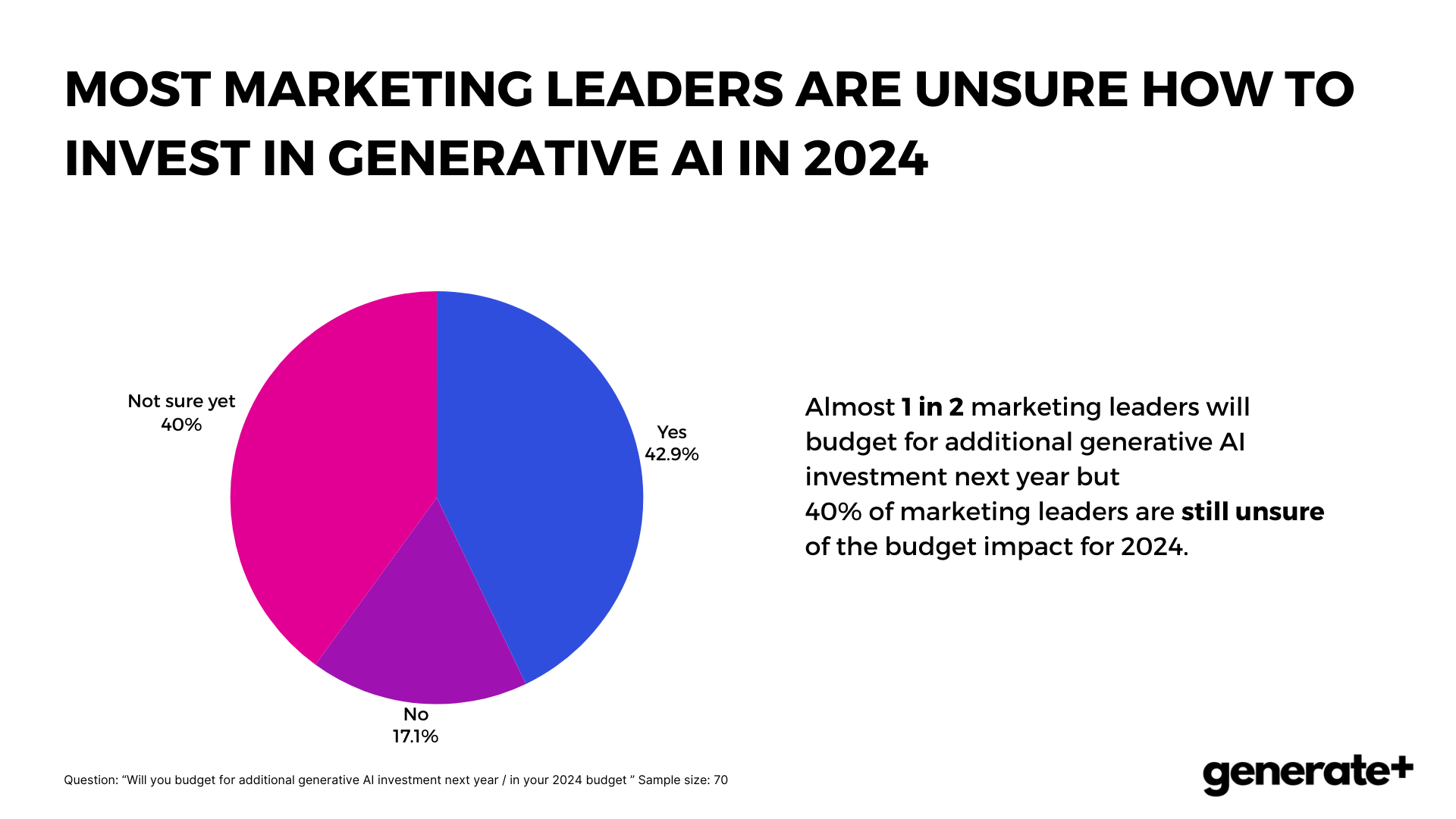
43% were ready to invest. Committed budget, treating AI as a capability to build rather than an experiment to run.
40% were undecided. The largest block of hesitation sat with leaders who could see the tools working but could not yet defend the spend internally.
17% were not increasing spend. Either satisfied with what the free and bundled tools delivered, or prioritising elsewhere.
Set the 43% against the 84.3% already using AI for copy and the picture resolves. Roughly half of the teams using AI were doing it without a budget for it. That is not caution, it is the ordinary shape of bottom-up adoption: usage arrives through individuals, procurement catches up later, and by the time a budget line exists the tools are already load-bearing.
The undecided group generally named the same three blockers. Return on investment was hard to isolate when the gains showed up as time saved rather than revenue booked. Data governance was unresolved, particularly around customer data and confidential material. And nobody wanted to standardise on a vendor in a market that was reshaping itself every few months.
The benefits marketing leaders actually report
Asked what AI had delivered, marketing leaders answered with operational gains far more than commercial ones.
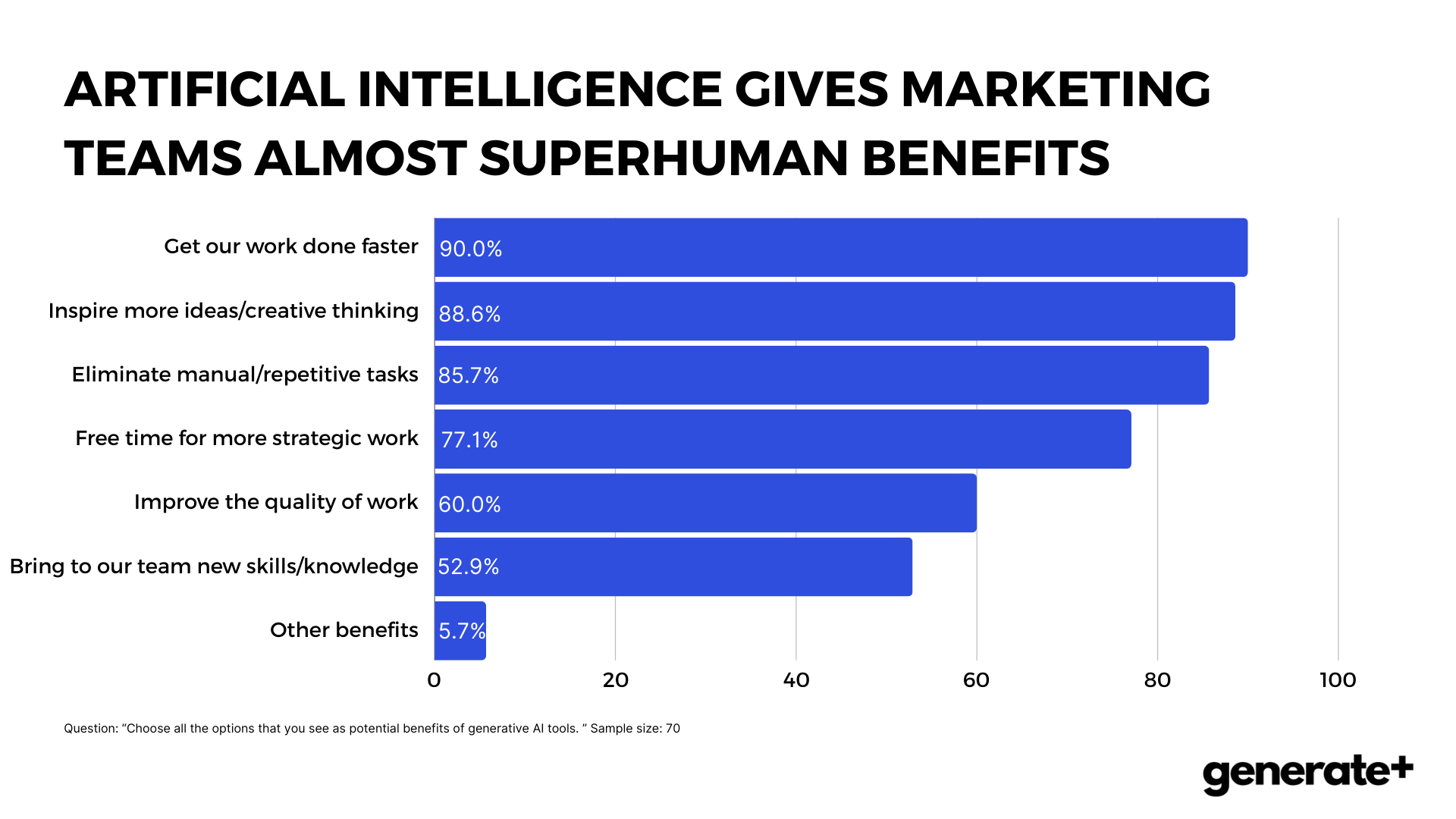
Speed of execution, 90%. The near-universal answer.
Creative inspiration, 88.6%. Value as a thinking aid, not only as a producer.
Task automation, 85.7%. Repetitive work removed from the week.
More time for strategic work, 77.1%. The stated payoff of the automation above.
Better quality of work, 60%. A notable drop, and an honest one.
Skill development, 52.9%. Teams learning something durable, not just shipping faster.
Other, 5.7%.
The 90% on speed against 60% on quality is the finding most worth sitting with. Marketing leaders were confident AI made their teams faster and much less confident it made the work better. Volume went up first. Whether standards followed depended entirely on what the team did with the time it got back.
What almost nobody claimed was revenue. Pipeline, conversion and win rate barely featured. Two and a half years on, that remains the honest state of most AI marketing programmes: the efficiency case is proven, the growth case is still being argued.
What marketing leaders expect from their agencies
AI reset the baseline for agency and freelancer relationships. Marketing leaders stopped treating AI use as a differentiator and started treating it as table stakes, which changes what a retainer is actually buying.
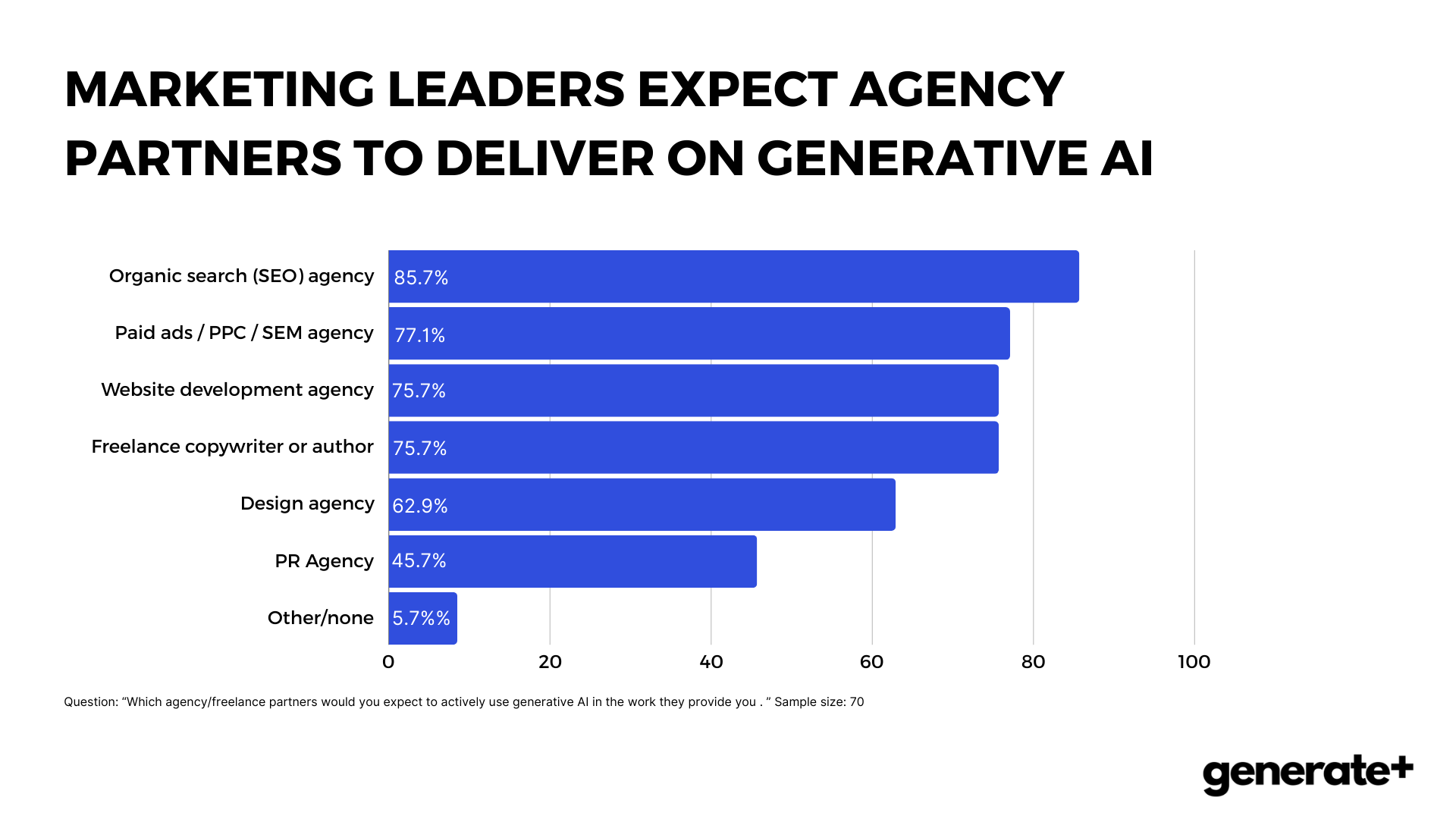
SEO agencies, 85.7% expected to use AI.
PPC and SEM agencies, 77.1%.
Web development and copywriting, 75.7%.
Design agencies, 62.9%.
PR agencies, 45.7%, the only category where a majority did not expect it.
The ordering follows how measurable each discipline is. Search and paid media are scored against numbers, so a tool that improves the numbers gets adopted without much debate. Public relations runs on relationships and judgment, and marketing leaders were reluctant to see it automated. That instinct is being tested now, because PR output is precisely what language models read when they describe a company.
For agencies the harder consequence is pricing. When clients assume AI is in use, the hours saved are expected to show up in the invoice. Agencies that priced by input have had a difficult two years. Those that priced by outcome have not.
What has changed since this survey
Three shifts stand out against this baseline, and each one is checkable against your own organisation.
Adoption stopped being the question. In 2023 the interesting number was how many teams used AI at all. Now essentially all of them do, and the interesting number is how much of the output anyone would defend. Volume is not a differentiator when everyone has it.
Governance arrived, late. The 40 tools per 70 companies figure described a market with no policy. Most organisations have since consolidated, usually onto whatever their existing platform vendors bundled. Consolidation solved the compliance problem and quietly narrowed the range of tools people experiment with.
Search became an answer engine. This is the change that matters most and the one least reflected in the survey, because in November 2023 nobody was asking about it. Buyers now ask a language model what a company does and get a composed answer rather than a list of links. That answer is assembled from whatever the model read about you, and your own website is only one input among many. This is the ground covered by AI search, AI Overviews and answer engine optimisation.
How this impacts your business
A language model does not look your company up in a register. It composes a description from everything it read during training and whatever it retrieves at the moment of the question. Trade press, directories, forums, competitor comparison pages, and somewhere in that mix your own website too.
So the description your buyer sees is assembled, not published. You do not control it, but you do supply a large share of the material it is built from. The teams that used AI for volume have, without intending to, produced a great deal of material that describes them imprecisely.
The traffic impact is still small, around one percent of sessions for most companies. The influence is not small, because the reader is often a buyer forming a first impression of what you do and who you serve, before any of your pages get a click.
Checking takes ten seconds. Type your company name into ChatGPT and read the answer. Most founders do not recognise the company being described.
Frequently asked questions
How many marketing leaders took part in this survey?
235 marketing leaders in Finland were contacted through LinkedIn and 70 responded, a 30% response rate. Both B2B and B2C organisations are represented, with the sample skewing towards internationally oriented software companies.
When was the survey fielded?
November 2023. It is published here as a Finnish market baseline for AI adoption in marketing, not as a current-quarter snapshot.
What do Finnish marketing teams use AI for most?
Written content. 84.3% of teams used AI for blog and website copy, ahead of creative thinking at 80% and social media at 60%.
Do Finnish companies budget for AI in marketing?
At the time of the survey, 43% of marketing leaders had committed to investing, 40% were undecided and 17% were not increasing spend. Adoption ran roughly twice as far ahead as budget.
Do marketing leaders expect their agencies to use AI?
Yes, in most disciplines. 85.7% expected it of SEO agencies and 77.1% of PPC and SEM agencies. Public relations was the only field where a majority did not.
Is this survey about generative AI or AI generally?
The questions focused on generative AI tools, since that was the new category. Finnish marketing teams were already using other forms of AI in advertising platforms and analytics, which the survey did not measure.
Written by Lari Numminen, Generate More. Also available in Finnish. Updated 31 August 2026.
-1.png)
Best Marketing Agencies for Supply Chain Software Companies in 2026
Best Marketing Agencies for ProcureTech and Procurement Software in 2026
.png)