

This guide is by Lari Numminen, founder of Generate More Oy, a Helsinki-based AEO and AI SEO agency for Nordic and international B2B software companies. Generate More finds out what ChatGPT and Google's AI say about a company, and fixes what sits underneath.
Search engine optimization (SEO) is the work of making your website the source search engines choose when someone asks about your field. Going into 2027 that means two things at once: ranking in Google's results, and being the page Google's AI Overviews, AI Mode and ChatGPT draw on when they write the answer. The fundamentals are the same for both.
| Search in Finland, going into 2027 | Figure | Source |
|---|---|---|
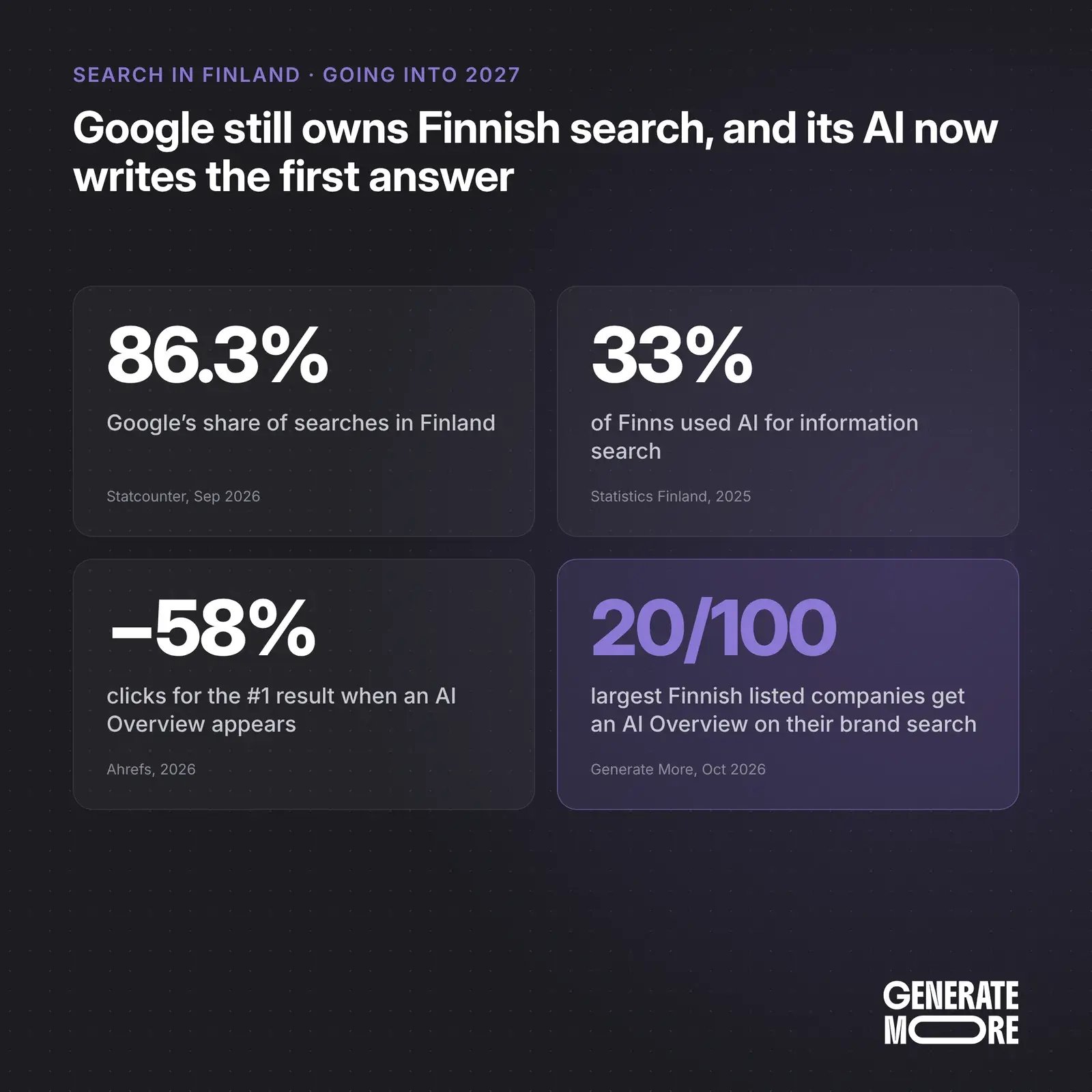
| Google's share of searches in Finland | 86.3% | Statcounter, Sep 2026 |
| Finns aged 16–89 who used generative AI in the past three months | 41% | Statistics Finland, 2025 |
| Finns who used AI for information search | 33% (up from 14%) | Statistics Finland, 2025 |
| Visits with a click on a regular result when an AI summary shows | 8% (15% without one) | Pew Research Center, 2025 |
| Drop in position 1 click-through rate when an AI Overview appears | 58% | Ahrefs, 2026 |
| Finland's 100 largest listed companies whose brand search shows an AI Overview | 20 of 100 (US: 73 of 100) | Generate More study, Oct 2026 (below) |
How search works in Finland going into 2027
Google still owns Finnish search. Statcounter puts its share at 86.3% for September 2026, with Bing a distant second at 5.6%. Whatever else you read about search changing, a Finnish company that is invisible in Google is invisible to most of its market.
Google is also where most AI search happens. SparkToro estimated that Google handled around 14 billion searches a day in 2024, roughly 373 times the number of search-like prompts sent to ChatGPT (SparkToro). AI Overviews and AI Mode run inside that volume, which makes Google's AI answer the one your buyers are most likely to read.
What has changed is the page Google shows. For a growing share of questions, the first thing a searcher sees is an AI-written answer assembled from several websites. Pew Research Center tracked 900 American adults through March 2025 and found that people who saw an AI summary clicked a regular result in 8% of visits, against 15% when there was no summary. They clicked a link inside the summary itself in only 1% of visits.
Finnish searchers are moving the same way. Statistics Finland reports that a third of Finns aged 16–89 used AI for information search in 2025, up from 14%, and among 16–34-year-olds the figure is over half.
The consequence for a B2B company is practical. Your buyer may read an answer about your category, or even about your company, without ever reaching your site. Search engine optimization today decides both whether you rank and what that answer says. Ahrefs has measured the cost. When an AI Overview appears, the first organic result now gets 58% fewer clicks, the second 50.8% fewer and the third 46.4% fewer, comparing December 2023 with December 2025 across 300,000 keywords (Ahrefs).
How big is the search engine optimization market in Finland?
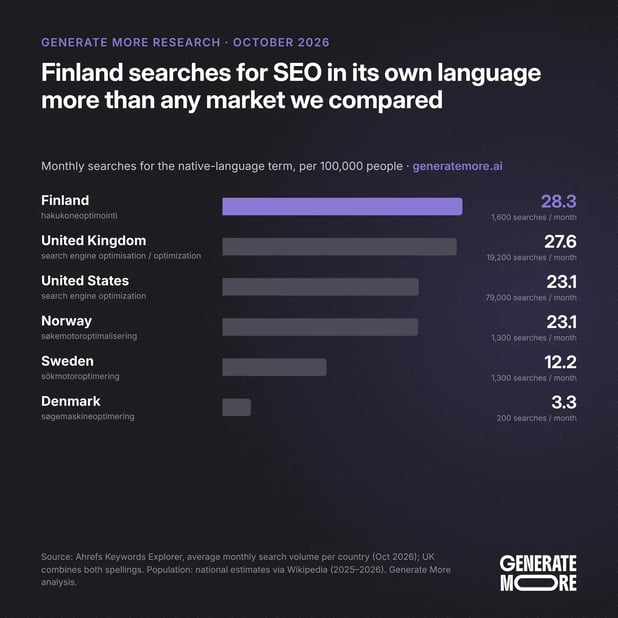
Finland is a small market that searches for SEO in its own language. I compared how often people search for the native-language term for search engine optimization in six countries, using average monthly search volumes from Ahrefs Keywords Explorer and national population estimates (Wikipedia).
| Country | Native-language term | Monthly searches | Per 100,000 people | Monthly searches for "SEO" |
|---|---|---|---|---|
| Finland | hakukoneoptimointi | 1,600 | 28.3 | 3,500 |
| United Kingdom | search engine optimisation / optimization | 19,200 | 27.6 | 34,000 |
| United States | search engine optimization | 79,000 | 23.1 | 497,000 |
| Norway | søkemotoroptimalisering | 1,300 | 23.1 | 2,300 |
| Sweden | sökmotoroptimering | 1,300 | 12.2 | 6,300 |
| Denmark | søgemaskineoptimering | 200 | 3.3 | 4,400 |
In absolute numbers Finland is small. Americans search for the English term about 49 times as often as Finns search for hakukoneoptimointi, and the British about 12 times as often. Adjusted for population, Finland comes first, with 28.3 searches a month per 100,000 people.
Language is what sets Finland apart in the Nordics. Finns search for their own term more often than Swedes search for sökmotoroptimering, in a country with nearly twice Finland's population. Danes have largely moved to the English acronym, with "SEO" getting 4,400 searches a month in Denmark and the Danish term 200. In Finland the Finnish word still makes up about a third of the combined searches (1,600 of 5,100).
For a Finnish B2B company this makes Finnish-language content a requirement. Buyers research the topic in Finnish, so the pages, and the AI answers built from them, need to exist in Finnish too.
Search volumes from Ahrefs are modelled estimates and less precise in small markets. "SEO" on its own also matches unrelated searches, which is why the comparison is built on the native-language terms.
The four parts of search engine optimization
Every SEO plan, from a one-person consultancy to a listed company, comes down to four areas of work.
Technical SEO: can search engines read the site?
Technical SEO (tekninen hakukoneoptimointi) makes sure Google and AI crawlers can fetch and understand every page you want found. It covers crawlability, page speed, mobile usability, clean URLs, internal links, hreflang for Finnish and English versions, and structured data.
A common failure on B2B sites is content that only appears after JavaScript runs. Google can usually render it; many AI crawlers cannot. If your service descriptions sit inside carousels or tabs, a crawler may see an empty page. Check that each key page reads cleanly as plain HTML.
Content and keywords: does the site answer real questions?
Keyword research tells you which words your buyers actually use. For a Finnish B2B audience this often means writing for two vocabularies, the Finnish term that most people search ("hakukoneoptimointi", 1,600 searches a month in Finland according to Ahrefs Keywords Explorer) and the English term that specialists use ("SEO").
Good content answers one question per page, clearly and early. The first sentence under each heading should state the answer, and the paragraphs after it carry the evidence. This structure helps readers who skim, and it is also how AI systems lift passages into their answers.
Links and mentions: does anyone else vouch for you?
Search engines judge a site partly by who refers to it. A link from a respected Finnish publication, a university course page or an industry association still counts for more than dozens of links from directories.
AI answers also weigh unlinked mentions. When an analyst, a "best agencies" list or a Wikipedia article names your company in the right context, AI models learn to associate you with that topic. In Kevin Indig's analysis of over 7,000 AI chatbot citations, brand search volume correlated with AI mentions at 0.334, while the most-cited pages actually had fewer backlinks than average.
Measurement: is any of it working?
Measurement closes the loop. Google Search Console shows which queries you appear for and where you rank. Analytics shows what visitors do next. For a B2B company the number that matters is pipeline. Count the deals that started with a search.
AI visibility needs its own tracking, since Search Console only covers Google's classic results. I've tested over 40 tools for this and summarized them in my comparison of AI visibility tracking tools. The simplest test costs nothing: ask ChatGPT and Google's AI Mode what your company does, and read the answer as a buyer would.
What changes when AI answers first
Google's documentation for site owners is unusually direct. "There are no additional requirements to appear in AI Overviews or AI Mode, nor other special optimizations necessary" (Google Search Central). A page that is crawlable, useful and trusted is eligible for both.
Selection is where the work lies. Google describes AI Mode as using "query fan-out", issuing several related searches across subtopics to build one answer. A company with a single page on a topic gets one chance to be picked. A company that also covers the comparisons and practical questions around it gets many. Three shifts follow from this, and they shape how I plan content for clients:
- Coverage beats a single ranking. Build clusters of pages around each topic your buyers research, linked to each other.
- Passages beat pages. Each section should make sense on its own, because AI systems quote individual sections.
- Your reputation is assembled elsewhere. What third parties write about you feeds the answer as much as what you write about yourself.
The AI-specific side of this work has its own name in Finnish, tekoälyoptimointi. I cover it step by step in the GEO guide.
How often Google shows an AI Overview for Finnish brands
I checked the brand searches of Finland's 100 largest listed companies to see how far AI answers have reached Finnish company names. The sample is the 100 largest Finnish companies on Nasdaq Helsinki by market cap (stockanalysis.com, 7 October 2026). For each brand name I read Google Finland's results from Ahrefs' SERP data, captured between late July and early October 2026.
Twenty of the 100 brand searches showed an AI Overview. Among the 25 largest companies only three did (KONE, Fortum and Tieto), while eight of the 25 smallest did. A smaller company is more likely to have Google describe it in an AI-written summary, assembled from whatever sources Google finds.
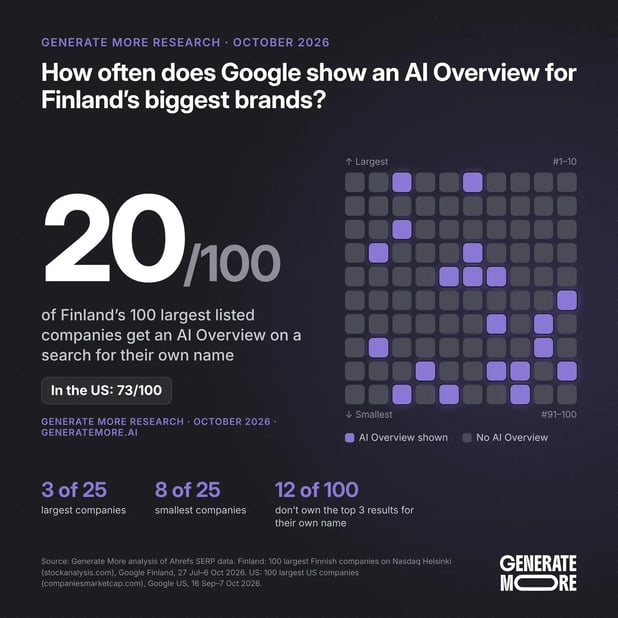
Finland is well behind the US on this. I ran the same check on the 100 largest US companies by market cap (companiesmarketcap.com, 7 October 2026) using Ahrefs' Google US data, and 73 of them showed an AI Overview for their brand name. My read is that Google's AI features simply reach Finnish-language searches later. The US results were also captured more recently, mostly in early October, so part of the gap may be timing. Either way, I expect the Finnish number to climb through 2027.
Ahrefs' own large-scale study points the same way. Across 92.5 million branded-keyword crawls of US desktop results, AI Overviews appeared on 73.3% of branded searches in September 2026, up from 61.3% in July (Ahrefs). The growth also shows why timing matters, since a Finnish snapshot taken in late summer probably undercounts what the same searches show today.
The classic results had a surprise of their own. For 12 of the 100 companies, other sites took the top three organic results for the company's own name. Neste and UPM were among them, with apps and news stories ranking above their own websites.
AI Overviews appear and disappear between searches, and Ahrefs records one snapshot per keyword, so treat the figures as a reading of the market this autumn. Even so, the direction is clear, and what Google says about your company is increasingly written by Google.
Search engine optimization for B2B companies
B2B search behaves differently from consumer search, and most Finnish SEO guides are written for webshops and local services. Three differences change the plan.
Search volumes are small. A query like "procurement analytics software" may get a few dozen searches a month in Finland, and that is fine when one deal is worth tens of thousands of euros. Judge keywords by buyer value, not by volume.
Buying committees research for months. A typical B2B purchase involves several people reading comparison articles, analyst lists and, increasingly, AI answers long before anyone fills in a form. The content that wins answers their questions at each stage. Early on, buyers want to understand the problem and the approaches that exist. Later they compare vendors and look for prices.
The AI answer is often the first impression. When a CFO asks ChatGPT which vendors to shortlist, the answer is built from everything published about your category. If your positioning changed recently, after an acquisition or a move into a new market, the answer may still describe the company you were two years ago. Checking and correcting that record is now part of search engine optimization.
How to do search engine optimization: a 90-day plan
The plan below is the sequence I use with B2B clients. It assumes a site of a few dozen pages and one person who can publish.
- Weeks 1–2, audit. Run a technical crawl, export three months of Search Console data, and ask three AI assistants what your company does. Note every gap between what they say and what is true.
- Weeks 3–4, research. List the 20–30 questions your buyers ask before they buy, in Finnish and English. Group them into three or four topic clusters.
- Weeks 5–8, fix and build. Fix the technical issues that block crawling. Rewrite the most important service page so its first paragraph answers the buyer's main question. Publish the first cluster, made up of one pillar article and three to five supporting articles.
- Weeks 9–12, earn mentions. Pitch your expertise to two or three Finnish trade publications, get listed in the relevant "best of" lists in your category, and update your profiles on the sites AI tools cite most in your field.
- Every month after, measure. Track rankings and clicks in Search Console, AI mentions in a tracking tool, and, most importantly, the leads that came through search.
In my experience, technical fixes show results within weeks, new content within three to six months, and reputation work over the longer run. Reputation compounds, because each mention makes the next one easier to earn.
What does search engine optimization cost?
Search engine optimization in Finland is usually bought in one of three ways: a monthly retainer, a fixed-price project, or in-house work supported by occasional consulting. Each suits a different situation.
Monthly retainers are the most common model for ongoing work. Clutch, which analyzed pricing across 65,550 SEO companies and their client reviews, reports that SEO agencies typically charge between $2,000 and $20,000 a month, with an average project of about $37,000 over 12 months (Clutch). In Finland, the B2B retainers I see typically run between €1,500 and €5,000 a month.
Projects suit companies with a specific problem, such as a site migration or a move into a new market. They are priced by scope and usually run for one to three months.
What drives the cost is how much needs to change. A company whose site is technically sound and whose market already understands it needs maintenance. A company whose buyers, Google and AI assistants all describe it wrongly needs its positioning rebuilt first, and that is a bigger job.
Is search engine optimization worth it?
Search engine optimization pays off when your buyers search before they buy, which in B2B is almost always. The practical question is how much of it to do yourself.
Doing it yourself works well for the fundamentals. A marketer who learns to read Search Console, write pages that answer one question each and keep the site technically clean will cover most of what a small company needs. Specialist help earns its cost in technical audits and migrations. It also pays off in the newer work of tracking and correcting what AI systems say about you.
Frequently asked questions
What does search engine optimization mean?
Search engine optimization (SEO, hakukoneoptimointi in Finnish) means improving a website so that search engines show it more often and higher for relevant searches. Since 2025 it also covers making the site a source that AI answers in Google and ChatGPT draw on.
How does search engine optimization work?
Search engines crawl websites, store what they find and rank pages for each search by relevance and trust. SEO works on all three steps: making pages easy to crawl, making the content answer the searcher's question and earning the links and mentions that signal trust.
How much does search engine optimization cost?
Internationally, SEO agencies typically charge $2,000–20,000 a month according to Clutch. In Finland, B2B retainers typically run between €1,500 and €5,000 a month in my experience. Projects such as migrations or repositioning are priced by scope.
How long does it take to see results?
Technical fixes can show results within weeks. New content typically takes three to six months to rank, depending on competition and on how much trust the site already has.
What is the difference between search engine optimization and GEO?
Search engine optimization aims to rank pages in search results. Generative engine optimization (GEO, tekoälyoptimointi in Finnish, closely related to AEO) aims to get your company cited and described correctly in AI-generated answers. The two share the same foundations, and the GEO guide covers the additional steps.
Can I do search engine optimization myself?
Yes, the fundamentals are learnable: a technically clean site, pages that answer real questions, and a habit of checking Search Console. Specialist help pays off in competitive markets, during migrations and when AI answers describe your company incorrectly.
Nordic AI Overviews Index: How Often Google's AI Answers a Search for the Nordics' Largest Companies
Finnish News Media and AI Bots: Who Blocks ChatGPT and Other AI Crawlers?
.png)